HACo: Learning Haptic Active Compliance for Force-Aware Dexterous Manipulation
1The University of Hong Kong
2Beijing Academy of Artificial Intelligence (BAAI)
3Johns Hopkins University
†Work done during an internship at BAAI.
Abstract
Contact-rich dexterous manipulation requires policies to translate physical feedback into motion commands that regulate interaction loads across evolving multi-contact interactions. This requires both haptic observations that capture the contact state and action supervision that demonstrates how motion commands should adapt to it. Existing policies often overlook the complementary roles of fingertip tactile sensing and joint torque. Meanwhile, commonly used action targets include nominal teleoperation commands, which can encode excessive loading, and observed configurations, which omit motion constrained by the object.
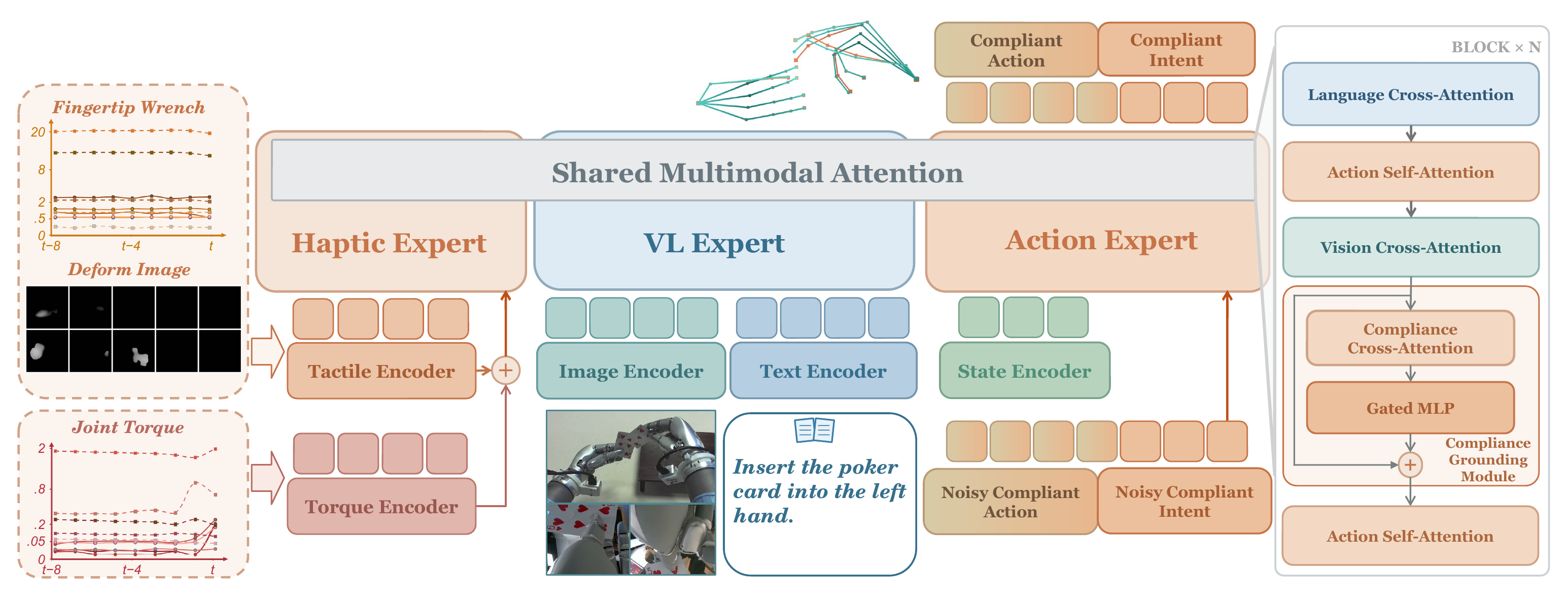
We introduce HACo, a Haptic Active Compliance policy that learns force-regulating actions directly from haptic feedback. Compliance-regulated teleoperation converts operator commands into controller-executable compliant actions that preserve motion intent while regulating interaction loads. HACo learns these compliant actions directly, with their command-state discrepancy providing auxiliary compliant-intent supervision. HACo further combines local contact responses from fingertip tactile sensing with load transmission through the articulated hand captured by joint-torque feedback, including contacts beyond tactile coverage. A Compliance Grounding Module grounds action generation in the evolving haptic state through gated haptic cross-attention, enabling closed-loop force regulation without explicit online contact modeling.
We evaluate HACo on a real-world benchmark spanning multi-contact friction, tangential interaction, fragile curved-surface contact, rotational torque, and deformable-object manipulation. Across 20 trials per task, HACo achieves an 83% mean success rate versus 35% for the strongest evaluated baseline. These results demonstrate HACo's ability to translate complementary haptic feedback into active compliance across diverse force-sensitive dexterous manipulation tasks.
Contributions
- We develop complementary haptic perception that couples fingertip tactile sensing with joint-torque feedback to represent both local contact and loads transmitted through the articulated hand.
- We formulate active compliance learning from regulated demonstrations, combining controller-executable compliant actions, compliant-intent supervision, and the Compliance Grounding Module for haptic-conditioned action generation.
- We introduce a real-world dexterous force benchmark spanning multi-contact friction, tangential interaction, fragile curved-surface contact, rotational torque, and deformable-object manipulation.
Method
HACo learns controller-executable compliant actions from force-regulated demonstrations and conditions action generation on haptic feedback.
Architecture
HACo conditions a flow-based action expert on multi-view images, language, robot state, and haptic histories. Its haptic expert first aligns fingertip wrench and deformation features with joint-torque features from the same finger, then fuses information across fingers into a structured haptic representation. The Compliance Grounding Module lets action features query this representation through gated haptic cross-attention alongside vision-language conditioning. Trained with conditional flow matching, the action expert predicts controller-executable compliant actions with auxiliary compliant-intent supervision.
Force-regulated demonstrations
Motion retargeting provides nominal arm and hand references. Cartesian admittance and fingertip force regulation adjust them before execution, preserving task motion while limiting excessive loads. The resulting compliant references are recorded with synchronized visual, state, tactile, and torque observations.

Compliant action learning
Observed motion omits commands blocked by contact, while nominal commands can apply excessive force. HACo instead learns the regulated compliant command. Its discrepancy from the observed hand state, Δqcit = qcmpt − qobst, supplies compliant-intent supervision during conditional flow matching.

Real-World Force Benchmark
Most prior work evaluates dexterous manipulation primarily through motion outcomes rather than force regulation. Our benchmark therefore comprises five multi-stage bimanual tasks spanning multi-contact friction, precise tangential-force control, fragile curved-surface contact, rotational torque, and deformable-object compression. While each task emphasizes a distinct interaction regime, all require the policy to complete the intended motion while regulating the physical interaction that makes completion possible.
Begin with two playing cards lying on the black platform. Use the right hand to pick up one card and transfer it to the left hand. Hold the first card upright and steady with the left hand. Then use the right hand to pick up the remaining card, align it with the card held in the left hand, and slide it into the same grip so that both cards are held together. Finish with both cards securely held in the left hand and the right hand released. Do not bend or drop either card.
Experiments
We evaluate whether HACo improves force-sensitive dexterous manipulation over visuomotor and tactile-augmented policies, then isolate the contributions of haptic perception, compliant-action learning, compliance grounding, and wrist-mounted visual observations. Every entry reports successful physical rollouts out of 20; Mean is the macro-average across the five tasks.
Main comparison
Compare HACo with visuomotor and tactile-augmented policies under the same five-task, 20-rollout evaluation protocol.
| Method | Insert poker | Open book | Draw on balloon | Unscrew cap | Squeeze toothpaste | Mean |
|---|---|---|---|---|---|---|
| GR00T | 3/20 | 0/20 | 1/20 | 7/20 | 4/20 | 15% |
| GR00T + Tactile | 5/20 | 2/20 | 1/20 | 9/20 | 5/20 | 22% |
| ViTacFormer | 0/20 | 1/20 | 0/20 | 2/20 | 1/20 | 4% |
| T-Rex | 4/20 | 6/20 | 2/20 | 12/20 | 11/20 | 35% |
| HACo | 18/20 | 17/20 | 14/20 | 19/20 | 15/20 | 83% |
Table 1b. Numerical policy comparison on the real-world force-sensitive dexterous manipulation benchmark.
HACo achieves an 83% mean success rate and leads on all five tasks, exceeding T-Rex by 48 percentage points and GR00T by 68. It also reduces mean fingertip force by 19% relative to GR00T, showing that the higher task success is accompanied by more compliant interaction. The modest gain from GR00T to GR00T + Tactile (15% to 22%) further indicates that simple tactile concatenation is not enough; this favors connecting haptic feedback to the evolving action representation.
Haptic perception ablation
Isolate the contributions of fingertip tactile and joint-torque feedback and compare factorized and coupled haptic representations.
| Haptic perception | Insert poker | Open book | Draw on balloon | Unscrew cap | Squeeze toothpaste | Mean |
|---|---|---|---|---|---|---|
| w/o Haptic Feedback | 7/20 | 2/20 | 3/20 | 8/20 | 7/20 | 27% |
| w/o Tactile Feedback | 8/20 | 5/20 | 7/20 | 13/20 | 12/20 | 45% |
| w/o Torque Feedback | 15/20 | 16/20 | 11/20 | 14/20 | 12/20 | 68% |
| w/o Coupled Encoding | 17/20 | 14/20 | 12/20 | 13/20 | 14/20 | 70% |
| HACo | 18/20 | 17/20 | 14/20 | 19/20 | 15/20 | 83% |
Table 2b. Numerical results for the haptic-perception ablation.
Removing all haptic feedback drops the mean success rate from 83% to 27%, confirming that physical observations are essential. Tactile feedback alone reaches 68%, compared with 45% for joint torque alone, so local contact is the dominant cue. Joint torque remains complementary: adding it improves every task and raises cap removal from 70% to 95%. Coupled encoding provides a further gain from 70% to 83%, supporting kinematics-aligned fusion across the hand.
Compliance learning ablation
Progressively introduce controller-executable compliant actions and auxiliary compliant-intent supervision from regulated demonstrations.
| Configuration | Compliant Action | CIS | Insert poker | Open book | Draw on balloon | Unscrew cap | Squeeze toothpaste | Mean |
|---|---|---|---|---|---|---|---|---|
| Nominal Action | — | — | 12/20 | 11/20 | 9/20 | 14/20 | 13/20 | 59% |
| Compliant Action | ✓ | — | 15/20 | 15/20 | 13/20 | 16/20 | 14/20 | 73% |
| + Compliance-Intent Supervision | ✓ | ✓ | 18/20 | 17/20 | 14/20 | 19/20 | 15/20 | 83% |
Table 3b. Numerical results for the compliance-learning ablation.
Keeping the compliant action target but removing compliant-intent supervision lowers the mean from 83% to 73%. Replacing that target with the nominal teleoperation command lowers it further to 59%. The larger loss from changing the action target shows that the controller-executable, force-regulated reference is the primary contribution, while compliant-intent supervision adds a complementary benefit by preserving the force-regulating command-state discrepancy.
Compliance grounding ablation
Hold haptic observations and compliant action targets fixed while varying how haptic state conditions action generation.
| Compliance grounding | Insert poker | Open book | Draw on balloon | Unscrew cap | Squeeze toothpaste | Mean |
|---|---|---|---|---|---|---|
| Visuo–Haptic Fusion | 10/20 | 6/20 | 7/20 | 10/20 | 8/20 | 41% |
| Action-Suffix Fusion | 14/20 | 9/20 | 6/20 | 11/20 | 7/20 | 47% |
| Compliance Attention | 14/20 | 15/20 | 11/20 | 16/20 | 10/20 | 66% |
| Gated Compliance Attention | 18/20 | 17/20 | 14/20 | 19/20 | 15/20 | 83% |
Table 4b. Numerical results for the compliance-grounding ablation.
Direct Visuo-Haptic Fusion and Action-Suffix Fusion reach only 41% and 47%, while dedicated haptic cross-attention reaches 66% and the complete gated CGM reaches 83%. Cross-attention gives the evolving action representation explicit access to contact evidence without disrupting the pretrained visual or action streams. The zero-initialized gate adds another 17 points by preserving pretrained computation at the start of adaptation and regulating reliance on noisy or intermittent haptic signals.
Wrist-camera ablation
Remove both wrist cameras while keeping the haptic observations and HACo policy otherwise unchanged.
| Camera observation | Insert poker | Open book | Draw on balloon | Unscrew cap | Squeeze toothpaste | Mean |
|---|---|---|---|---|---|---|
| w/o Wrist Cameras | 13/20 | 15/20 | 14/20 | 18/20 | 16/20 | 76% |
| w/ Wrist Cameras | 18/20 | 17/20 | 14/20 | 19/20 | 15/20 | 83% |
Table 5b. Numerical results for the wrist-camera ablation.
Removing both wrist cameras reduces the mean success rate by only 7 points, from 83% to 76%. This modest drop suggests that haptic feedback recovers contact state that is difficult to observe under visual occlusion. Wrist views remain useful, but the result indicates that sensing anchored at the interaction interface provides a more direct and robust contact representation.
Failure Cases & Limitations
Representative unsuccessful rollouts reveal distinct limitations in contact-rich manipulation.
Insufficient Tangential Separation
Because the thumb fails to enter the middle of the page stack, it cannot establish enough tangential traction to separate the target section. The pages therefore move together instead of opening at the intended location.
Missed Contact Onset
The balloon slips out of the left hand during drawing. This occurs because the right hand does not recognize that the marker has already made contact and continues its motion, creating a disturbance that exceeds the left hand’s stabilizing grip.
Excessive Pickup Force
Due to excessive normal pressure from two right-hand fingers, inter-card friction rises at pickup, causing two cards to be lifted as one stack rather than separating a single layer.
Nozzle–Brush Misalignment
The toothpaste is dispensed beside the bristles instead of onto them. The reason is inaccurate nozzle–brush alignment: the policy produces the squeezing action without tightly coupling visual placement to haptic evidence of extrusion.
Citation
If you find our work helpful, please cite it below.
@misc{ye2026hacolearninghapticactive,
  title         = {HACo: Learning Haptic Active Compliance for Force-Aware Dexterous Manipulation},
  author        = {Naisheng Ye and Yinzhe Zhou and Junkai Zhao and Yuhang Lu and Checheng Yu and Zhenjie Yang and Pengwei Wang and Hongyang Li},
  year          = {2026},
  eprint        = {2609.36596},
  archivePrefix = {arXiv},
  primaryClass  = {cs.RO},
  url           = {https://arxiv.org/abs/2609.36596}
}
This website draws inspiration from the open-source ENPIRE project-page template and the T-Rex project page. We thank both teams for sharing their work.